Down Payment for Home: How Much You Really Need (And How to Get There)
Feb 2026, By Home Qualifiers

A down payment is simply the cash you bring to closing—the upfront money you put toward your home purchase before the mortgage covers the rest. In the U.S. in 2024, most buyers put down somewhere between 3% and 20% of the home price, depending on their loan type, credit profile, and financial situation.
A down payment is simply the cash you bring to closing—the upfront money you put toward your home purchase before the mortgage covers the rest. In the U.S. in 2024, most buyers put down somewhere between 3% and 20% of the home price, depending on their loan type, credit profile, and financial situation.
If you’ve been told you need 20% saved before you can even think about buying, here’s the truth: that’s not a requirement for most first-time homebuyers. Recent data shows the median first-time buyer puts down around 8–10%, and many loan programs allow 3% or even 0% down for eligible buyers. According to the National Association of Realtors, the median down payment for first-time homebuyers in 2024 was just 9%.
At Home Qualifiers, down payment planning is Step Two in the 3-step pathway to homeownership—coming after credit profile optimization and before mortgage pre-approval. It’s not a separate puzzle piece; it’s part of a connected plan. Your down payment amount affects your loan approval, your interest rate, your monthly mortgage payment, and how quickly you build equity in your home.
The goal isn’t to save endlessly. There are many costs involved in buying a home, including the down payment, closing costs, and other expenses. It’s to understand your real numbers, connect them to a realistic timeline, and stop guessing about what it takes to own a home.

What Is a Down Payment on a Home?
A down payment is the portion of the home’s purchase price you pay in cash at closing. The lender covers the remaining balance through your mortgage loan.
Here’s how it works in simple terms:
- You find a home listed at $350,000
- You put 5% down ($17,500)
- The lender finances the remaining $332,500
- You now own the home, owe the lender, and start building equity
That upfront payment represents your “ownership stake” from day one. Lenders require a down payment as part of their payment requirements for approving a mortgage. It shows the mortgage lender you have skin in the game—real money invested—which reduces their risk if something goes wrong.
A few important clarifications:
- Down payment ≠ closing costs. Closing costs are separate fees (typically 2–6% of the home’s purchase price) that cover appraisals, title insurance, lender fees, and other expenses. Closing costs typically account for 2% to 6% of the home’s purchase price.
- Down payment ≠ earnest money. Earnest money is a smaller deposit (often 1–3%) you submit with your offer to show you’re serious. It usually credits toward your down payment at closing.
- Down payment ≠ moving costs. Budget separately for movers, furniture, and immediate repairs.
In Home Qualifiers’ 3-step system, Step Two focuses specifically on down payment planning and strategy—built around your actual income, debts, and savings goals, not generic advice that ignores your real life.
How Much Do You Actually Need? (Typical Minimums by Loan Type)
The minimum down payment required depends on your loan type, credit score, debt-to-income ratio, and the property you’re buying. But here’s good news: most first-time homebuyers can start with 0%–5% down, not the 20% you may have heard about.
Here are typical 2024 minimums for major U.S. loan programs:
- Conventional conforming loans: The minimum down payment for a conventional fixed-rate loan is 5%, though some programs allow as low as 3% for qualified borrowers with strong credit (typically 620+ FICO) and qualifying income.
- FHA loans: A Federal Housing Administration (FHA) mortgage has a minimum down payment of only 3.5% with a credit score of 580 or higher; 10% down if your score falls between 500–579.
- VA loans: VA loans, backed by the U.S. Department of Veterans Affairs, usually do not require a down payment and are available to eligible borrowers who are current or veteran military service members and some surviving spouses.
- USDA loans: USDA loans, backed by the U.S. Department of Agriculture, also have no down payment requirement in eligible rural and some suburban areas, with income limits (typically ranging to 115% of area median income).
- Jumbo loans: Often 5%–10%+ down, depending on the lender and loan amount (these are for homes exceeding conforming loan limits, currently $766,550 in most areas)
Keep in mind that individual lenders can set stricter rules than program minimums. A mortgage lender in your state may require higher down payments or better credit than the baseline. Always confirm current guidelines before assuming you qualify.
Here’s where it connects: improving your credit score through Step One (credit profile optimization) can unlock lower down payment options and more flexible loan programs. Better credit doesn’t just mean better rates—it means more choices.
Loan-to-Value Ratio (LTV): How Your Down Payment Changes the Math
Lenders don’t just look at your down payment in dollars—they calculate your loan-to-value ratio (LTV), which compares your loan amount to the home’s value.
The formula is simple:
Loan Amount ÷ Purchase Price (or Appraised Value, whichever is lower) = LTV
For example, on a $400,000 home:
- 20% down ($80,000) → $320,000 loan → 80% LTV
- 10% down ($40,000) → $360,000 loan → 90% LTV
- 5% down ($20,000) → $380,000 loan → 95% LTV
- 3% down ($12,000) → $388,000 loan → 97% LTV
Why does LTV matter? Lenders see lower LTV as lower risk. When you have more equity from the start, they’re more confident they can recover their money if you default. This often translates to better rates, easier approvals, and avoiding certain insurance requirements.
Home Qualifiers helps users understand how improving credit and adjusting their down payment amount can move LTV into an approval-friendly range—without requiring years of extra saving.
Do You Really Need 20% Down?
Let’s address this directly: 20% down is a benchmark, not a requirement.
The 20% figure comes from a specific benefit—avoiding private mortgage insurance on conventional loans. But it was never meant to be a barrier that keeps everyone from buying until they’ve saved for a decade.
Recent data shows that first time home buyers typically put down around 8–10%, while repeat buyers average closer to 14–18%. The 20% down payment is the exception, not the rule.
You generally need to put 20% down to avoid private mortgage insurance (PMI) on a conventional loan.
When 20% down can be beneficial:
- Avoids PMI on most conventional loans (saving $100–$300+ monthly)
- Reduces your loan balance and monthly payments
- Makes your offer more competitive in hot markets
- Often required or preferred for jumbo loans
When less than 20% makes more sense:
- Home prices are rising faster than you can save (common in many U.S. markets since 2020)
- You need savings for repairs, emergencies, or unexpected expenses after closing
- You have high-interest debt (like credit cards at 20%+ APR) that’s costing more than PMI would
- You’d rather buy your first house now and build equity instead of paying rent indefinitely
The “right” down payment amount is personal. Home Qualifiers uses a Roadmap Call to help buyers decide whether purchasing sooner with PMI or saving longer for 20% fits their actual life—not someone else’s formula.
Minimum Down Payment vs. Smart Down Payment
There’s an important difference between the minimum down payment allowed and what’s actually healthy for your budget.
Just because you can buy with 3% down doesn’t mean you should—if it leaves you with no emergency fund. Having enough money saved for a larger down payment is important, as it can lead to payment saving through lower monthly payments and better mortgage terms. Conversely, stretching to 20% down while draining every savings account isn’t wise either.
Consider these factors beyond the down payment number:
- Total monthly housing costs: Principal, interest, taxes, insurance, PMI, and HOA fees combined
- Emergency savings: Can you still cover 3–6 months of essential expenses after closing?
- Debt obligations: Will you still have room for car payments, childcare, or medical bills?
- Home maintenance: Roofs leak, appliances break, and that’s normal homeownership
Making a larger down payment typically results in smaller monthly mortgage payments, which can help you save more over time.
A Home Qualifiers advisor walks through real numbers—your income, debts, current rent, and target price—to recommend a down payment range that balances buying sooner with staying financially safe.
How Your Credit Score Impacts Your Down Payment Options
Your credit score doesn’t just affect your interest rate—it changes which loan programs and minimum down payments you qualify for in the first place.
Here’s how score bands typically affect your options:
| Credit Score Range | Typical Down Payment Options |
|---|---|
| Below 580 | Often need 10% down for FHA; limited conventional options |
| 580–619 | Can access FHA at 3.5% down in many cases; conventional may require higher down payments or be unavailable |
| 620–679 | More conventional 3%–5% options available; better pricing than lower bands |
| 680+ | Widest choice of low-down-payment products with competitive rates |
For example, Rocket Mortgage offers flexible down payment options and lower minimum credit score requirements, making it accessible for a wider range of buyers.
Here’s what this means practically: improving your credit by even 20–40 points can unlock a lower down payment requirement and save you thousands over the life of the loan.
This is exactly why credit sits at Step One in the Home Qualifiers pathway. Before diving into down payment strategy, it makes sense to optimize your credit profile—removing errors, addressing negative items, and strengthening payment history. A cleaner credit profile makes Step Two (down payment planning) more flexible and realistic.
If you’ve been denied for a mortgage before, you likely don’t need “perfect” credit to try again. You need a targeted plan to clean up specific issues and get your profile into an approval-ready range.

Private Mortgage Insurance (PMI) and Other Mortgage Insurance
When you put less than 20% down on a conventional loan, lenders typically require private mortgage insurance. PMI protects the lender (not you) if you default on your mortgage loan.
How PMI works on conventional loans:
- Usually required when LTV is above 80% (meaning you put less than 20% down)
- Charged as a monthly fee added to your mortgage payment
- Typically costs 0.5%–1.5% of your loan amount annually (e.g., $100–$300/month on a $250,000 loan)
- Can be removed once you reach approximately 20% equity and meet lender guidelines
FHA and USDA mortgage insurance works differently:
- FHA loans: Include an upfront mortgage insurance premium (1.75% of the loan, usually rolled into the mortgage) plus annual mortgage insurance payments. With down payments under 10%, this insurance often lasts the life of the loan.
- USDA loans: Include a 1% upfront guarantee fee plus an annual fee built into your monthly payment.
The tradeoff is real but manageable. Paying mortgage insurance allows you to purchase with 3%–5% down instead of waiting years to reach 20%—years during which rents and home prices may continue rising. There are other benefits to homeownership, such as building equity, potential tax advantages, and stability, that can outweigh the cost of PMI for some buyers.
Home Qualifiers helps buyers run side-by-side scenarios during the Roadmap Call: buying sooner with PMI versus saving longer for a higher down payment. Sometimes the math clearly favors one option; sometimes it depends on your priorities.
When Paying PMI Can Actually Make Sense
PMI isn’t always the enemy. Paying PMI can allow you to buy a home sooner, rather than waiting years to save a larger down payment. Here are situations where buying with 5% down and PMI may be smarter than waiting:
- Rapidly rising home prices: If homes in your area are appreciating 5–7% annually, waiting two years to save more money could mean the same home costs $30,000–$50,000 more
- Family stability needs: School district, commute time, space for kids—these matter now, not in three years
- High rent that rivals mortgage payments: If you’re paying $2,200/month in rent while a mortgage with PMI would be $2,400, you’re not saving much by waiting—you’re just building someone else’s equity
Remember: PMI isn’t permanent on most conventional loans. Once your equity passes 20% (through payments or home appreciation), you can often request removal. Many borrowers only pay PMI for 5–7 years, not 30.
A balanced plan protects your emergency fund rather than draining every dollar into the down payment just to avoid PMI.
Benefits of a Larger Down Payment (When You Can Afford It)
Not everyone can or should aim for 20%+. But if your financial situation allows it, a larger down payment offers real advantages.
Core benefits:
- Smaller loan amount and lower monthly mortgage payment
- Often better interest rates and loan terms
- Ability to avoid PMI on conventional loans at 20% down
- More immediate equity, which protects you if the market slows or you need to sell sooner than planned
- Stronger offers in competitive markets where sellers prefer buyers with more cash upfront
- Higher down payment requirements may apply for second homes or investment properties compared to primary residences.
Simple comparison on a $350,000 home (estimated):
| Down Payment | Cash at Closing | Loan Amount | Approx. Monthly Payment* | PMI? |
|---|---|---|---|---|
| 5% ($17,500) | $17,500 | $332,500 | ~$2,350 | Yes |
| 20% ($70,000) | $70,000 | $280,000 | ~$1,900 | No |
*Assumes 6.5% rate, 30-year term, includes estimated taxes and insurance. Your actual numbers will vary.
That’s roughly $450/month difference—money that could go toward savings, retirement, or handling unexpected expenses.
Home Qualifiers helps buyers identify whether stretching to a higher down payment genuinely improves their financial life or just delays homeownership unnecessarily.
Lower Interest Rates and Better Loan Terms
Lenders often reward larger down payments and stronger credit with lower interest rates. Their logic: you’re borrowing less, and you’ve proven financial discipline.
A 0.25%–0.50% rate difference might sound small, but over 30 years, it can mean paying $20,000–$45,000 less interest on your home loan.
Credit improvement (Step One) and down payment planning (Step Two) work together here. A cleaner credit profile plus a solid down payment positions you for the best pricing tier you can realistically reach.
Smaller Monthly Payments and Less Stress
Borrowing less (because you put more down) combined with a potentially lower interest rate means smaller monthly payments. But the benefit isn’t just mathematical.
Smaller monthly costs mean:
- More room in your budget for saving, travel, or family activities
- Less anxiety about making ends meet during tight months
- Lower risk of missed payments that could damage your credit
Think about a monthly mortgage payment range where you can still comfortably afford life—not just survive until the next paycheck.
Faster Equity Building and Safety Net
Equity is simply your home’s value minus what you still owe. A bigger down payment means you start with more equity on day one.
Why does this matter?
- Selling flexibility: If you need to relocate, you’re less likely to owe more than the home is worth
- Refinancing options: More equity means better refinance terms if rates drop
- Emergency access: Home equity can become a safety tool through careful refinancing or home equity products (though this should be approached cautiously)
- Market protection: If home prices flatten or dip, more initial equity means less risk of going “underwater”
How to Decide Your Down Payment Amount (Without Guessing)
There’s no magic number. The right down payment is the one that gets you approved while keeping you financially stable.
Start by asking yourself these questions:
- How stable is my income, and do I have 3–6 months of emergency savings?
- How long do I expect to stay in this home (3–5 years vs. 10+ years)?
- Do I have high-interest debt (credit cards, personal loans) that’s costing more than mortgage interest would?
- How quickly are rents and home prices moving in my area?
- What would my projected mortgage payment be at 3%, 5%, 10%, and 20% down?
Some buyers are better off putting slightly less down to keep their emergency fund intact. Others might save money long-term by putting 10% down and avoiding years of PMI.
Home Qualifiers uses each person’s credit profile, income, and target price range to map out 2–3 realistic paths. For example: “Buy in 6 months at 5% down with PMI” versus “Buy in 18 months at 10% down without PMI.” Both might be valid—the question is which fits your life.
Balancing Down Payment, Debt, and Savings
Here’s a principle that surprises some buyers: sometimes paying off high-interest debt makes more sense than adding money to your down payment.
Consider this:
- Credit card interest: 20–25% APR
- Mortgage interest: 6–7% APR
Paying down $5,000 in credit card debt saves you more in interest than putting that same $5,000 toward a slightly larger down payment.
It’s also risky to empty savings just to hit a 20% target—especially for families with moderate incomes, single-income households, or anyone without a financial safety net.
A practical approach:
- Decide on a minimum emergency fund (3–6 months of essential expenses)
- Calculate what’s left after that
- Determine your realistic down payment target
In the Home Qualifiers Roadmap Call, advisors help set these guardrails so your plan feels secure, not fragile.
Strategies to Save for a Down Payment (That Real People Can Actually Do)
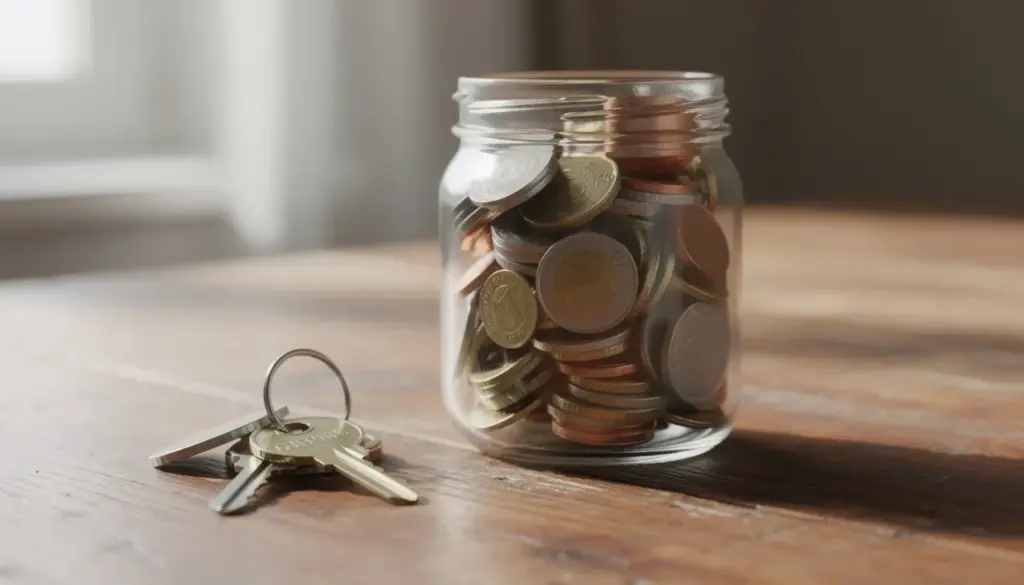
Saving even 3%–5% can feel overwhelming when you’re already paying rent and managing everyday costs. That’s a normal feeling—not a personal failure.
Here are realistic strategies that work:
Automate your savings:
- Set up automatic transfers to a separate “home fund” savings account every payday
- Even $200–$400 per paycheck adds up to $5,200–$10,400 per year
Redirect windfalls:
- Tax refunds (average ~$3,000)
- Work bonuses
- Side gig income
- Gifted money from family (more on this below)
Temporarily reduce non-essentials:
- Downgrade streaming subscriptions ($30–$50/month saved)
- Cut dining out frequency ($100–$200/month saved)
- Pause gym memberships you rarely use ($40–$60/month saved)
Set a concrete target: Instead of “save as much as possible,” try “$15,000 by June 2026.” Then break it down:
- $15,000 ÷ 18 months = ~$833/month
- Or ~$417 per biweekly paycheck
Here’s encouraging news: improving your credit (Step One) can reduce your future interest rate and sometimes allow slightly lower down payments. Your savings target might be more reachable than you assume.
Home Qualifiers ties these savings goals directly to realistic timelines so you see a clear path—not a vague “someday.”
Down Payment Assistance Programs and Gifts
Many buyers don’t realize help is available.
Payment assistance programs:
- States, cities, counties, and nonprofits offer down payment assistance through grants, forgivable loans, or low-interest loans
- Average grant amounts hover around $7,500, though this varies widely
- Most programs require income caps (often 80%–115% of area median income), minimum credit scores, and occupancy requirements
- Search for programs based on your specific location—requirements differ significantly
Family gifts:
- Many loan programs allow gifts from family for all or part of the down payment
- Proper documentation is required, including a “gift letter” stating the money doesn’t need to be repaid
- Rules vary by loan type, so confirm requirements with your mortgage lender
Home Qualifiers advisors help buyers understand how assistance programs and gifts affect their required down payment, closing costs, and approval timeline.
How Home Qualifiers Helps You Go From Stuck to Keys-in-Hand
Home Qualifiers operates on a 3-step pathway designed to take you from wherever you are today to actually owning a home:
Step One: Credit Profile Optimization Identify and address negative items on your credit report, strengthen payment history, and improve scores using guided tools and monitoring. This isn’t about perfection—it’s about getting approval-ready.
Step Two: Down Payment Planning & Strategy Create a personalized savings plan, explore payment assistance programs, and decide the right down payment target and timeline for your situation. This is where budget clarity, debt prioritization, and realistic goal-setting happen.
Step Three: Mortgage Pre-Approval Connect with a qualified mortgage professional once your credit and down payment are aligned. Pre-approval becomes more likely to stick because you’ve done the preparation.
Home Qualifiers is not a mortgage lender. It’s not a quick-fix credit repair shop. It’s a structured pathway that walks buyers from “I was denied” or “I’m just renting” to “I’m actually approved.”
The goal is progress and clarity, not perfection. Even if you can’t hit 20% down, you can still build a plan that works with 3%–10% down—as long as it’s intentional and fits your budget.
By understanding how down payments, credit, and monthly budgets work together, you can stop feeling shut out of homeownership. The path to your first house isn’t a mystery—it’s a series of steps. And now you know what they are.
Home Qualifiers partners with lenders that are Member FDIC and adhere to fair housing standards, ensuring your deposits and transactions are secure.